Cassidy Gard Says Your Perfectionism Isn’t Ambition. It Might Be Survival.
There’s a specific kind of woman the world rewards early.
The hyper-capable one. The emotionally attuned one. The good girl. The one who can read a room before anyone says a word. The one who keeps functioning, keeps achieving, keeps smiling, while her nervous system is quietly holding a clipboard and screaming, “Ma’am, we are not okay.” From the outside, it looks like ambition, but underneath it, sometimes it’s survival. And Cassidy Gard knows that version of womanhood intimately.
In her memoir, Cosmic Goodness: Surrendering the Shadows to Live in the Light, Cassidy traces her evolution from the daughter of an alcoholic Deadhead father to a woman learning how to trust herself, her intuition, and what she calls the “cosmic winks” of the universe (one of my personal favorite parts). It is a story about growing up in chaos, chasing success, battling anxiety and perfectionism, becoming a mother, and slowly realizing that healing does not require becoming someone new. It often begins by finally telling the truth about who you have been all along.
“My Perfectionism Was Never Really About Achievement. It Was Survival.”
One of the most powerful threads in Cosmic Goodness is Cassidy’s exploration of perfectionism, not as a personality trait, but as a trauma response.
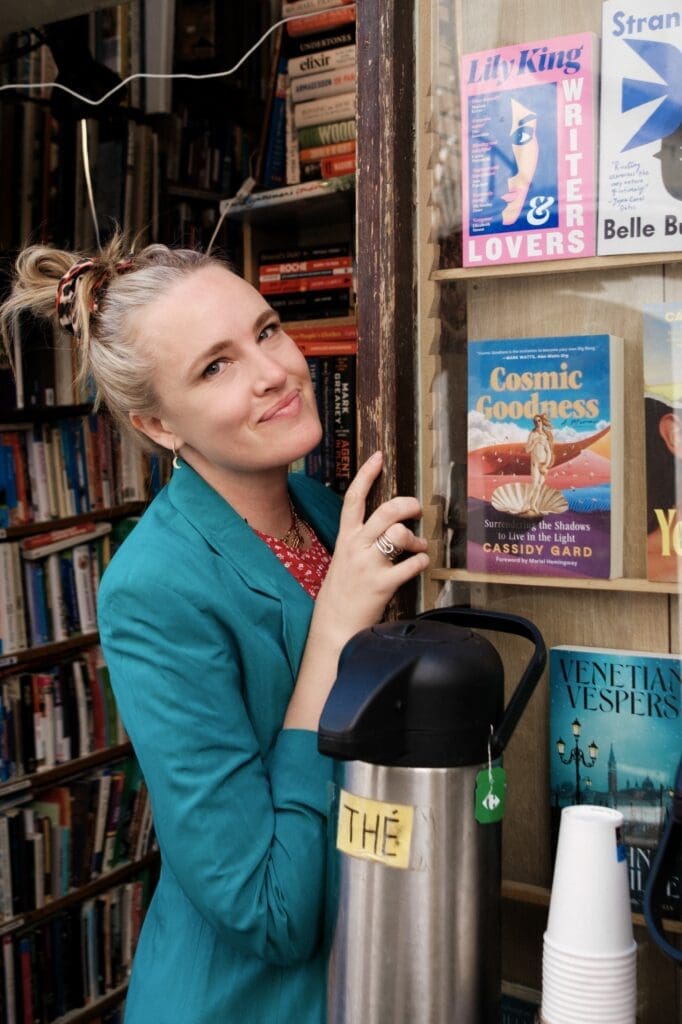
“It was revealed to me when I started going to Al-Anon, a twelve-step program for people affected by alcoholism. Around the room were all these sayings like ‘progress not perfection,’ and I kept hearing people talk about healing their perfectionism. It was eye-opening to realize that so many children, spouses, and parents of alcoholics carried this same instinct to over-function and control. That was the moment I understood my perfectionism was never really about achievement. It was survival. When you grow up in an unpredictable environment, you become hyper-vigilant. You try to anticipate every emotional shift before it happens. You believe that if you can just do everything perfectly, maybe chaos won’t reach you. Realizing that changed the way I understood my entire life.”
That is the part so many women will feel in their bones. Because when you grow up around unpredictability, the brain learns to scan for moods, tension and danger. It’s scanning for the tiny shift in someone’s voice that tells you the whole room is about to change. Research around childhood trauma and nervous system dysregulation shows that hyper-vigilance can become a survival adaptation. So what looks like being “so mature for your age” is often a child learning how to stay safe.
Cute? No. Effective? Unfortunately, yes.
The Exhaustion of Reading Every Room
Cassidy’s ability to read people eventually became useful in her career as a television producer, a world where energy, urgency, and personalities are basically part of the job description. “There were parts of being highly attuned and sensitive that genuinely helped me in my career as a television producer. A huge part of that role is managing energy, keeping the peace, and reading the room before anyone else does. On a production set, there are endless personalities and pressures moving at once, and I became very skilled at navigating that. But the truth is, it is also incredibly draining to live that way all the time. You become so focused on everyone else’s emotional state that you lose touch with your own.”
That line says everything: becoming so focused on everyone else’s emotional state that you lose touch with your own. Being emotionally attuned can look like a gift from the outside, and sometimes it is. But when it comes from growing up in an unstable environment, it can also become exhausting. You’re not just reading the room. You’re managing the room, absorbing the room, and trying to keep the whole damn room from catching fire.
Cassidy sees it differently now, especially as a mother.
“Now, as a mother, I see emotional attunement differently. I find deep value in creating emotional safety for my children because it actively teaches them to understand and regulate their nervous systems. That feels meaningful to me. Doing that same emotional labor for grown adults, over and over again, eventually became exhausting. I had to learn the difference between compassion and self-abandonment.”
Compassion is beautiful. Self-abandonment is a trap wearing nice shoes.
When Achievement Stops Working
Cassidy built a successful career in industries that often reward the exact patterns trauma can create: over-functioning, perfectionism, performance, and the ability to make it all look effortless. And for a while, achievement did feel healing.
“In some ways, yes. Making my own money felt healing because it gave me a sense of freedom and empowerment. I loved knowing I could support myself and build the life I dreamed about through my own work.”
But achievement has a tricky little habit of disguising survival as success. And for Cassidy, the shift began when she realized there might be another way to build a life, one that did not require constantly pushing through exhaustion.
“During the pandemic, buying the Montana property and transforming it into an Airbnb became an unexpected miracle in my life because it allowed me to step into entrepreneurship. The property was already operating as a rental when I bought it, but I completely reimagined it. I poured so much intention into the branding, the feeling of the space, the emotional experience of arriving there. I wanted people to walk in and instantly exhale.”
She wasn’t just creating a rental, she was creating a feeling, a place that reflected the kind of safety she had spent years trying to find.
“At the same time, I also understand the larger conversations around Airbnb and housing shortages. I understand why some communities feel frustrated. My property is a little different because it sits on six acres with a level of privacy and separation, but I still think it’s important to acknowledge those realities honestly.”
That honesty feels important too, because the story is not simply “woman buys cabin, heals everything, cue sunset.” The reality is more nuanced, which is usually where the good stuff lives.
“Personally, though, the space gave me liberation. As a mother, being able to spend time with my children while still generating income changed everything for me. It showed me another way to live.”
But before that liberation came, her body forced her to pay attention. And often we ignore that feeling, but sometimes our bodies won’t let us.
“I did. I had a panic attack during a lunch break at the newsroom. I went out to my car to do a therapy session, and I could not stop crying. When I came back inside afterward, I suddenly couldn’t remember the password to log into my computer. I had used the exact same password every single day for seven years, and it was just gone from my mind. I remember calling IT, and the man on the phone sounded confused while I kept repeating, ‘I can’t remember. I can’t remember.’”
This is the part of burnout we do not talk about enough. It is not always a dramatic collapse. Sometimes it is your brain refusing to retrieve a password it has known for seven years. Sometimes it is crying in your car between meetings. Sometimes it is your body staging a quiet rebellion because your mind has been ignoring every signal.
“That moment terrified me because I realized my nervous system was completely overwhelmed. My body had been carrying stress and hyper-vigilance for so long that it finally shut down. It was a huge turning point for me. I knew something in my life had to change because I could no longer force myself to function through exhaustion.”
Studies from Harvard University and other leading research institutions have shown that prolonged stress can impact memory, cognition, and emotional regulation, which is science’s very fancy way of saying: eventually, the body stops letting you pretend you’re fine.
The Good Girl Has Left the Group Chat
One of the strongest emotional currents in Cosmic Goodness is Cassidy’s unlearning of people-pleasing. “It looked like allowing things to fall apart without rushing in to fix them. It looked like sitting with the discomfort of disappointing someone and not immediately trying to manage their feelings so I could feel safe again. That was the hardest part for me, learning that other people’s discomfort was not my emergency.
“People pleasing sounds gentle on the surface, but underneath it is often fear. Fear of rejection, fear of conflict, fear of being misunderstood. Unlearning it required me to stop overexplaining myself and stop trying to earn love through self-sacrifice.”
People-pleasing gets marketed as kindness because it looks pretty from the outside. But often, it is fear of doing community service. In trauma work, this is sometimes connected to the fawn response, where the nervous system tries to create safety by appeasing, accommodating, or becoming whatever keeps conflict away. And honestly, the sentence “other people’s discomfort was not my emergency” deserves to be embroidered on a pillow and then thrown at anyone who asks you to “just be the bigger person.”
Motherhood and the Smallest Acts of Healing
Motherhood cracked open another layer of Cassidy’s healing.
“Motherhood made everything feel incredibly full circle for me. My oldest son is very similar to me, impulsive, sensitive, full of life, and emotion. When he becomes perfectionistic about a toy or upset that something did not go the way he imagined, I feel so much tenderness toward him because I remember exactly what that feeling was like. I consciously try to make mistakes feel safe and playful in our home. If he spills something or knocks something over, we turn it into a game instead of shame. To me, that is what generational healing actually looks like. Not grand speeches or perfect parenting. Just one ordinary moment in the kitchen where you choose something different than what was chosen for you.”
That is the kind of healing people do not always post about because it does not look dramatic enough. It is not a sound bath in a silk set. It is not a retreat photo with a caption about expansion. It is a spilled drink in the kitchen and a mother choosing play instead of shame.
And science backs the importance of that kind of moment. Children learn emotional regulation through co-regulation, which means they borrow calm, safety, and emotional cues from the adults around them. Healing a family pattern does not always happen in one giant breakthrough. Sometimes it happens when a child makes a mess and no one makes them feel like they are the mess.
Healing Is Not Aesthetic
Cassidy is very clear that true healing does not always look like the wellness version. “I think true healing looks like honesty and authenticity. In my book, I write a lot about friendship because I really believe the people around us reflect where we are emotionally. It can be painful to outgrow old versions of yourself, and sometimes friendships evolve beautifully alongside you, while others cannot stretch to keep up with your growth.
We outsource it to partners, jobs, approval, aesthetics, achievement, wellness routines, social media validation, and occasionally an overpriced serum that promises radiance but cannot fix our childhood.
“I want to be around women who are in an active relationship with their own becoming. Women who are willing to look honestly at themselves and continue evolving. I write in the book, ‘You cannot outsource your becoming,’ and I believe that deeply. Healing is not aesthetic. It is messy and uncomfortable and deeply human. In the epilogue of my book, I write very candidly about the messiness of healing and that it isn’t linear.”
And then she dropped this… “You cannot outsource your becoming.” That is one of those lines that follows you around.
Because we try, don’t we? Becoming is internal work..annoying and inconvenient, but absolutely liberating.
Cosmic Winks Are Not Fluff

One of the most beautiful parts of Cassidy’s work is how she writes about intuition and synchronicity without making it feel detached from real life. “I really believe intuition is a constant state of attunement, and the more attuned we become, the sharper our clarity gets. Journaling was where it started for me. I would go back and read entries from months earlier and suddenly see all these little signals I had walked right past. The invitation was always there. My intuition has become one of the most important guiding forces in my life, and I want to teach my sons how to honor theirs too. I think survival mode disconnects us from ourselves because we are constantly reacting instead of listening. When life slows down enough for us to become quiet, we begin hearing what was underneath the noise all along.”
That is where spirituality and nervous system science start holding hands. When the body is in survival mode, we are often reacting to threat, urgency, and overstimulation. That can disconnect us from interoception, which is the ability to sense what is happening inside the body. Hunger. Tightness. Dread. Calm. Knowing. The little internal signals we ignore until they become impossible to miss.
Journaling, stillness, and reflection help create enough space to actually hear yourself again.
Trust Starts Small
For anyone stuck in burnout, fear, or perfectionism, Cassidy believes the way back begins with paying attention.
“I really believe in journaling because it captures the signals. When you read back later, it becomes remarkable to see how many pieces were already there long before you recognized them consciously. The signs were present. The invitations were present. You just couldn’t fully see them yet. So much of healing begins by becoming still enough to hear yourself again. We spend so much time consuming noise, advice, expectations, and pressure that we lose connection with our own inner knowing. Trust starts small. It starts with paying attention.”
That feels like the heartbeat of Cosmic Goodness.
Not a demand to become someone else. Not a promise that everything will suddenly become easy. Just an invitation to notice what has been there all along.
Creating the Sanctuary She Never Had
During the pandemic, Cassidy bought a cabin in Paradise Valley, Montana, and named it Cosmic
And the way she talks about that land makes it clear this was never just a property. It was a reclamation.
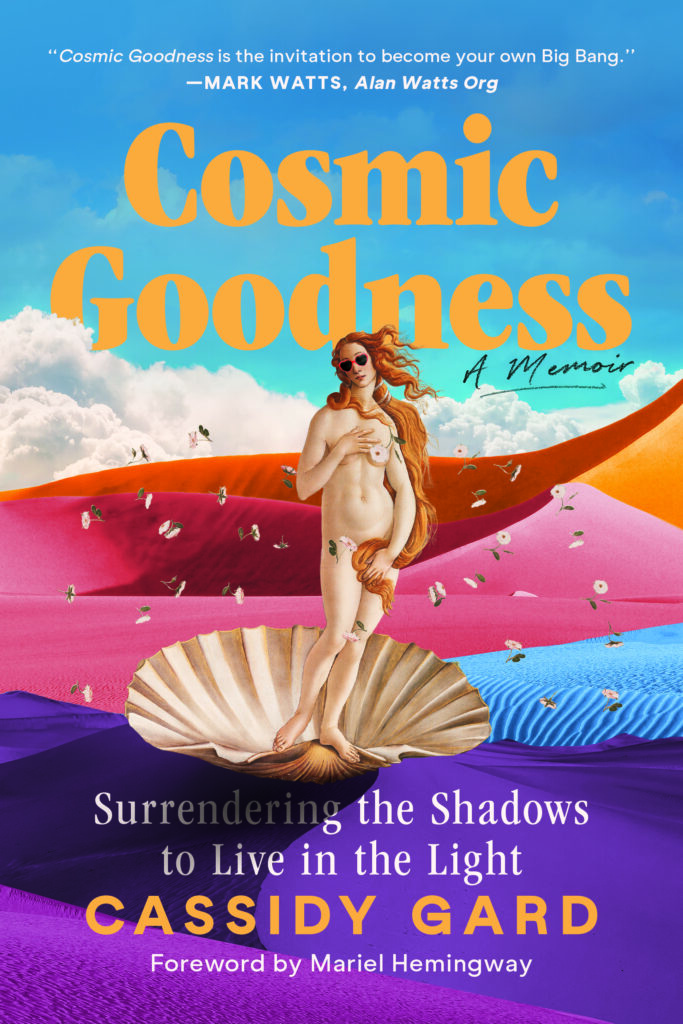
“I created the sanctuary I never had growing up. I’m thirty-six now, and I think a lot about legacy. When I bought that land during the pandemic, it represented safety, peace, beauty, and possibility to me. There are six acres there, and I hope it stays in our family for generations.
And maybe that is what Cassidy’s entire story is really about. A woman learning to start building a life that finally feels authentic and safe enough to belong to her…and wow, does that feel refreshing.
Inspired? I thought so. So go pick up this book and read it…RIGHT NOW.